“He who has a why to live can bear almost any how.” Certainly, it’s not until your sources of food have run and you’ve turned to cannibalism that this becomes quite the appropriate Nietzschean insight. Broadly too, Frostpunk arguably embodies this notion wholeheartedly in its pursuit of city building effort that separates itself from its genre stablemates where a happy ending appears an impossible destination on a journey strewn with tough, morality affirming choices to be made.
With the Earth gone to hell in a frosty hand-basket, there are very few enclaves that can support human life – and this is where you come in. As the shepherd of the bedraggled remains of humanity you must usher them into one such enclave, ensuring that their needs are met and, most importantly understand what type of person you must become to get the job done.
Another day, another RPG to play. I do love role-playing games and the genre itself is probably up there amongst my favourites. The issue these days is that nearly every game has RPG elements, is an actual RPG or it really, really wants to be one. A good game of this type will need to stand out, do something different and be of a very high quality. A Knight’s Quest is an open-world game for PS4 is one that fits this mould, let’s see how it measures up against its competition.
A Knight’s Quest PS4 Review
You play as Rusty, a happy go lucky adventurer who accidentally sets off a chain of events that threaten the world you live in. You set out on a quest to right the wrongs of your ever-snowballing mishap, seek out the mysterious Guardians, find the Spirit Knights and save the world. It’s quite a generic tale that is quite blandly written but it was comical in places when it did not try too hard to be humorous. It’s not a bad tale overall and did not distract me from my goal, it’s just not very memorable and gave me very little drive to carry on with the main storyline.
When it comes to racing games, Codemasters know their onions. A veritable swathe of polished and deep racing games have been born from their Warwicksire HQ for over 20 years, with franchises improving and growing each year. The arrival of the first GRID game for the latest generation of consoles is an exciting proposition for racing fans, particularly as the previous GRID releases on the last generation are all of considerable merit. But how does the format stand up against the competition?
GRID PS4 Review
Wheels of Wonder
On booting up, you are greeted with a grid (get it?) of 91 races across 6 multiple racing championships which you can dip in and out of to accumulate credits to buy new cars, and to unlock the final showdown which eventually gives you access to the big cheese ‘GRID World Series’. There’s a LOT of racing here.
Career-wise, there are six different championship classes.The Touring Cars series (souped up saloon cars) continues the brilliant series started back in 1997 with TOCA Touring Car Championship on PSOne. It also includes the rather lumpen Australian touring cars and circuits.Stock Cars (souped up American saloon cars) transfers the four wheel action into North America with higher powered but very heavy vehicles. Like NASCAR without the dizziness of the ovals. ‘Trucks’ or flatbed 4x4s also feature in the championship to mix things up a bit.
Anyone who doesn’t like racing classic minis has a cold dead heart
Meanwhile, Tuner (souped up Japanese road cars) mirrors the first two series, set primarily in Japan. Gran Turismo without the grinding. The GT series offers up a selection of souped up sports cars found on the likes of the Le Mans 24 hour race across an international track selection. With Fernando Alonso on-board as a consultant, his team FA Racing is a brand new racing class in itself, which leads to an opportunity to race against the man himself.
The Open Wheel F1000 series within sits between karts and F1 and is an exhilarating low to the ground, high speed racing car series. Along with the single seater open wheelers, there is a smattering of GT and Tourers on the way to the showdown with the testy Spaniard. Finally, the Invitational series provides a nice selection of classic cars including racing Minis, Ford GT40s, Ferraris, Porsches, Volvo estates (!) and Ford Sierras. When it comes to the number of vehicles, Compared to Gran Turismo Sport and Project Cars 2, GRID’s 60 cars available at launch is fairly minimal but no doubt this will increase with future DLCs.
Race car ya-yas
If you’ve not played any of the GRID games on PS3, getting stuck in to the first batch of races reveals a solid arcade racer, dressed up as a simulation. Project Gotham 4 is the closest comparison, or some sort of love child of Project Cars 2 and Drive Club, complete with a kudos system for following the racing line, drafting, drifts and numerous other skills. Codemasters claim the balance is 80% sim and 20% arcade but they appear to have the numbers the wrong way around.
Relive the heady days of the 80s council estates with the souped-up Ford Sierra
The kudos system is a keen indicator that GRID has been directed ever more towards arcade racing fans, and the change of direction is reinforced by the damage system.
Even on the most harsh setting, there’s very little realism in the damage meted out to your car for full-on collisions with other vehicles. This means that you’re free to bully your way to the front of a gaggle of opponents simply by ramming into them which undermines the entire core of the gameplay. The only way to cause terminal damage is if you hit rocks or a wall, and even then there isn’t much in the way of consistency.
One of the key elements which has made the GRID series work so well up this point, has been the necessity to drive in a realistic manner for fear of causing yourself damage which may lose the race. The combination of the forgiving damage system and the Codies’ trademarked rewind system (press Y to correct a mistake up to five times during a race), means that you never feel like you’re on the edge of your seat.
Stay away from the rear-end of the person in front or they could be your NEMESIS!
Resident Wheelvil: Nemesis
GRID’s sole USP appears to be the ‘Nemesis’ feature – collide with another driver during a race event and your new nemesis will subsequently deliberately block or shove you but whilst remaining within the boundaries of realism. You can potentially create a whole field of nemeses if you can ram enough of the other drivers during a race, but by the next event in the tournament, they’ve forgotten about your naughtiness. Unfortunately, rather than instilling fear in you when you see your nemesis ahead of you on the track, it never takes much to get around them and the whole feature ends up feeling like a rather pointless addition.
The developers claim there are potentially 400 different AI characters to battle with, but aside from the ones that you’ve successfully riled, the standard A.I. is very passive to the point of only following the racing line and patiently queuing if you manage to block the track after a skid. In fact the ‘Nemesis’ aggression only highlights how lacking in character the A.I. drivers are.
The brilliant street circuits are some of the highlights of the game
Get on the right track, baby
Aside from the rather dull Sydney Motorsport Park circuit, GRID’s limited pre-DLC track selection is mostly a choice regurgitation of old GRID tracks. The street circuits of San Francisco, Barcelona and the new Havana track offer up some incredible high speed battles as you weave through the chicanes, narrowly missing walls and power sliding around cobbled bends. GRID’s finest fictional circuit Okutama returns with glorious new lighting and detail and will be gratefully received by previous players of the series as will Brands Hatch and Silverstone, both packed with unpredictable high-speed corners.
Shanghai, Sepang and Zhejiang feature throughout each car series and are brilliantly rendered, if a little bland. Indianapolis and Crescent Valley round out the selection, so overall just a smattering of what was on offer from previous GRID games, but presumably more are due in good time.
Slippery when wet
Good looking boy
You’ll be pleased to hear that GRID looks absolutely staggering, even on a base PS4. Fans of the GRID series will be glad to know that the cockpit view presents you with an almost photo realistic version of the interior of the car, and for racing wheel owners, there is a vast array of supported devices.
As you’d expect from Codemasters, the weather effects are top drawer and the tracks and cars glisten convincingly during a downpour, with blinding reflections from the road as the sun peeks through the clouds. The visual feedback adds a whole lot to the experience, with camera shake subtly conveying the bumps as you fly over kerbs or graze the walls. The cars themselves look as good as you’ll get from this generation of consoles from whatever angle you choose to race from. The race replays merely reinforce the glory of how this game looks.
The tracks are teeming with details, with convincing spectators (who react if you crash near them!) and off-track details like funfairs, helicopters and balloons all add to the sense of occasion.
After rear-ending the rest of the pack to get in front, you can wave bye bye to this shiny bonnet / hood
Further on down the road
As with most modern racing games, GRID has a meaty career and an online multiplayer, which will provide all the spills and thrills you need whilst listening to a 12 year old gloating at you down the headset. The multiplayer enables you to add to your career credits to spend on new vehicles, and can host up to 16 players.
Strangely, the option to hire and fire your team mate in the single player career mode is hidden away in the options screen. More skilled team-mates can be unlocked as your career progresses, and you can ditch your current colleague when you have riled them into a nemesis… The team mate is a fairly inconsequential part of progressing through the career though, so perhaps that’s why the developer plopped it ‘around the back’.
“Help! I’m being chased by a whole pack of nemeses!”
Getting away scot-free
So what we have here is a supremely polished and playable arcade racer with a large swathe of racing challenges stretched thinly over a scant array of tracks and a nice selection of perfectly rendered cars. Ignoring the pointless Nemesis feature, the main problem is the fact that the cars are practically impossible to damage, and therefore the game doesn’t penalise you for ramming your way to the front at every opportunity. Take away the risk and you’ve taken away the excitement.
It’s a great shame that Codemasters have failed to innovate the GRID series too. There is significantly less content than the 2014 PS3 release GRID: Autosport, and in the five years between the two games, the only idea that someone in the office had was to stick a red triangle over the cars you’ve been rear-ending and call them your nemeses.
No doubt the content will grow as the DLC comes out, but unless the damage system is patched, there’s not a great deal of challenge here other than trying to stay awake through the single-player career.
GRID releases on PS4, PC and Xbox One on October 11, 2019.
The controller market is growing into quite a competitive one. With Razer and SCUF already showcasing their own products, Thrustmaster has entered the ring, featuring the eSwap Pro Controller. Much like the aforementioned controllers, the eSwap has its own unique features. Do they help it stand out among the rest of the market?
Thrustmaster eSwap PS4 Controller Review
Top notch construction
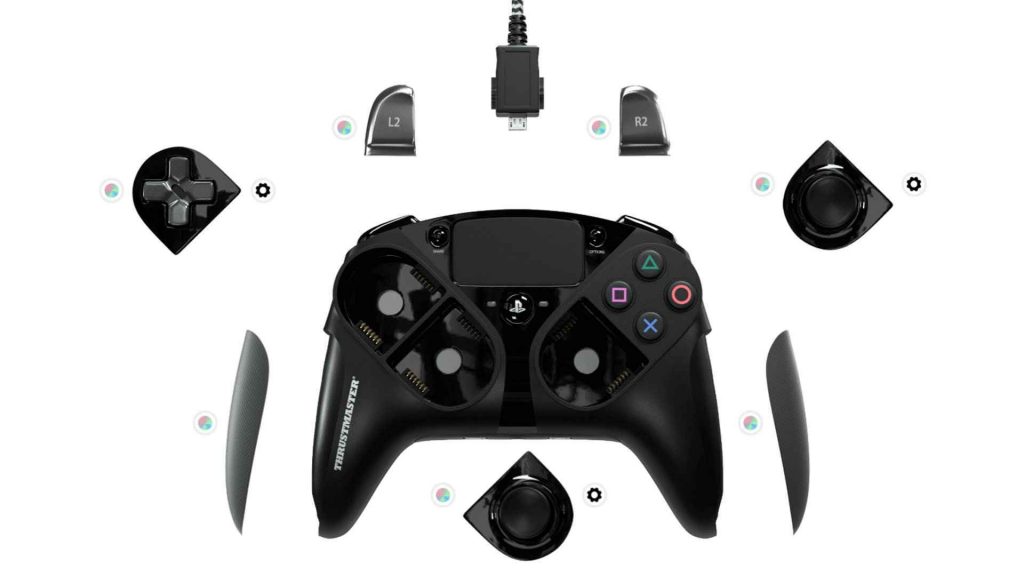
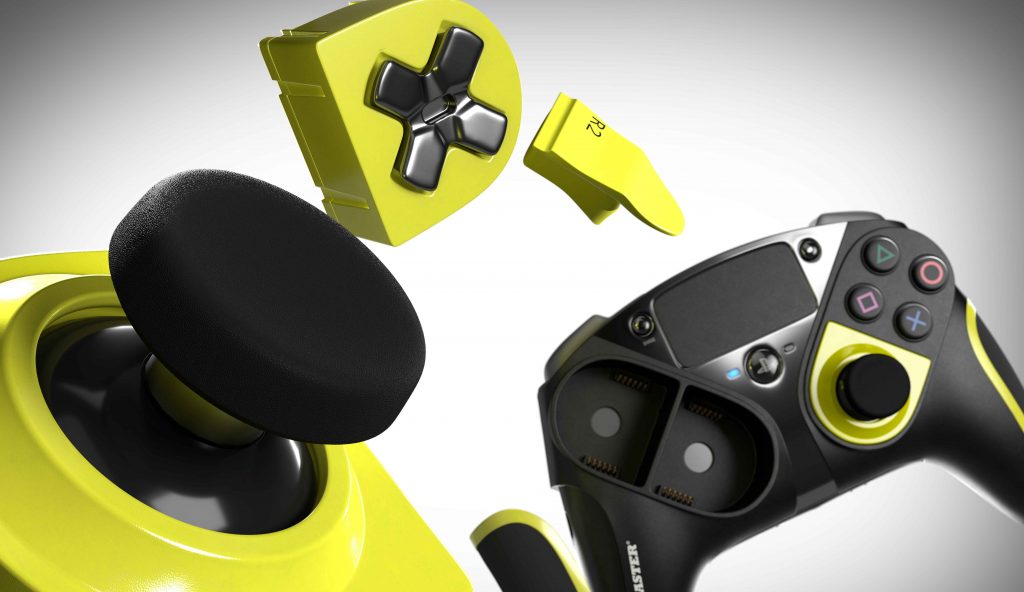
The most appealing feature of the eSwap comes with changing out different parts of the controller. Granted, if you want to change colors of certain things, you’ll have to pay a little more for different T-Mod Color Packs, but that option remains available. The Joysticks and D-Pad all freely slide out and stay in place via magnets between the contact points. I find myself from time to time just fidgeting with a Joystick, taking it out and putting it back in again.
Different T-MOD packs, sold separately, allow you to swap out different colored modules for extra customization.
Swapping out parts is pure joy
This feature also expands the potential buyers. Not only can you swap out different colors for each slot, but the Left Joystick and D-Pad can be interchanged as well. This allows fans of offset joysticks to play PS4 more enjoyably. Or, if you’re like me, it allows you to just change the colors around just because you like it.
One aspect of this controller that surprised me the most were the Joysticks, because they are adaptive pieces that can be taken out. I never question Thrustmaster’s quality, but I still had an inkling of doubt that the Joysticks would have some sort of limitation to them in order to compensate for convenience. Was I pleasantly surprised. These Joysticks offer zero resistance when pushing them, and they never delay in returning to rest position (with basically no reverberation when doing so).
What makes a good controller
This brings me to my final point. This isn’t something I’ve ever really had to put into words before. At the same time, I always expect it. If I can forget that I’m holding a controller, then that controller is doing its job.
Two controllers have done this for me. Those are the Dualshock 4, and the other is the Thrustmaster eSwap. Another factor to consider is that my hands are slightly below average in length, sitting 0.6 inches below the average 7.6-inch male hand size. My experiences with other high-end controllers have asked me to regularly adjust my grip to compensate for button positioning, especially with the trigger buttons.
I never had this problem with the eSwap. All my fingers reached exactly where they needed to, including the four customizable buttons on the back, which rested perfectly under my middle and ring fingers. The framework looks very similar to the Xbox’s S Controller, but it feels like a Dualshock 4. While aesthetics are great and all, the feel of a controller takes precedence for me, and the eSwap takes the cake.
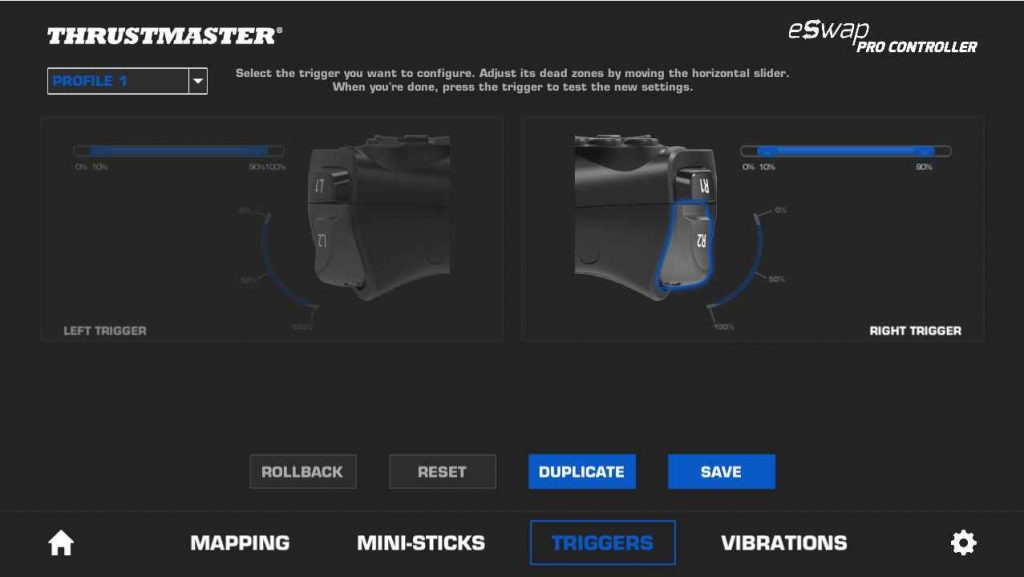
Thrustmapper allows you to adjust Joystick dead zones, trigger sensitivity on both ends, vibration intensity, and much more.
To add to this, having the ability to adjust the controller’s settings, via the provided Thrustswapper software, makes this controller almost feel like it was meant for your hands. You want the joysticks to have a little bit of dead zone with higher sensitivity? Do it. You want one trigger to be much more sensitive than the other? Cool beans, you can do it.
A few limitations
One aspect of the controller did take a bit to acclimate to. Being used to the DualShock 4 triggers, I had to get used to pulling a bit harder on the eSwap’s triggers. They do not resist your pulling, but they do require a bit of extra effort. Couple that with them slightly protruding further than DS4’s triggers as well.
This combination makes the extra effort noticeable for a little while, especially so if you play shooters. At the same time, these triggers create that sensation of actually pulling triggers, without having hair-trigger sensitivity. I found myself picking my shots more often rather than unloading all the time. It was initially an oddity that soon disciplined my gameplay to be less sloppy.
On the bottom of the controller are buttons for different button layout profiles and a mute button (one button on each side of the headphone jack). These buttons sit in a rather convenient location while staying out of the way. However–and this won’t be a problem for everyone–when I set my controller down, I tend to grab it from the front with my hand opened across the center. This left me quite often pressing one of those buttons, especially since I play with my headset wired into the controller.
On the subject of wired controllers, the eSwap is exclusively a wired controller. What I didn’t know was that I couldn’t use it to power on my PS4 from Rest Mode. This surprised me, since the power light on the controller remains lit, confirming that it still has power. I then knew that I could not use it to completely power on my PS4.
One other downside to the eSwap is one that may not affect everyone. With the power cord connecting where the Light Bar would normally be, there is no room for the Light Bar to exist on this controller at all. This means you’ll have to reach for the DualShock 4 if you play a game that needs it. If you’re like me, you also miss out on navigating the on-screen keyboard with the Light Bar.
While this controller feels so good to use, the wired aspect will keep this from being my exclusive controller. At the same time, the DualShock 4 is a tough act to follow. So, to me, this doesn’t really stand as a negative. It just means I have really good options now.
The Thrustmaster eSwap has some top-notch construction to say the least.
Peculiar vibrations
Right out of the box, the controller’s vibration function felt almost nonexistent. There were times while playing when I had expected the controller to respond to something going on, but I felt nothing. However, I got comfortable with my game enough to pay more attention to the controller, and I began to feel very, very subtle vibrations as they happened.
As I played other games, I learned that each one provided a different level of vibration intensity without my changing the controller’s settings in the provided Thrustmapper software. I also spent some time adjusting the vibration intensity on each side, and I learned that the left and right side do not vibrate in the same way. While they feel like the intensities are the same, they just have different feels on both sides. The right side feels like vibrations in a small space while the right side comes across like vibrations in a wider space.
When activated together, though, vibration feels clean and synchronized somehow. It’s odd, knowing that they vibrate at different intensities. Either way, the end result is what matters, and the two slightly varied vibrations do not feel varied when both are activated. I can’t think of a game that uses divided vibration, so most will not experience this divide, but I mention it strictly for transparency.
Thrustmaster eSwap Pro shines
All in all, the Thrustmaster eSwap Pro Controller impresses with its sleek design, feel, customizability, and pure function. A few things make it a bit finicky to work with, but nothing keeps it from becoming that go-to controller.
I really, really like Indivisible. My entrancement with the game was utterly unexpected. I’m not very familiar with developer Lab Zero games. I have never played their previous hit, Skull Girls. I don’t really care for platformers. At first glance, screenshots of the art style kinda turned me off. I had only heard of the game maybe a week before the review code came drifting in.
But then I fired Indivisible up, and the characters came to life with a wit and grace that is beguilingly charming and at times laugh-out-loud funny. The art in motion is so beautiful that I actually got up from my sofa at certain points so I could examine character details with my face almost touching the TV.
And the battle system? Come on. Ludicrously good.
Glowing giant pillar jump attack – hoooooo!
Indivisible PS4 Review
Indivisible’s Characters Are Fantastic
Indivisible tells the story of Ajna, a rebellious and slightly irresponsible young lady being trained in the ways of combat by her warrior father. When her village is unexpectedly destroyed by an invading force, Ajna is left as the lone survivor.
When she learns that the incursion came at the behest of warlord Ravannavar (voiced by Star Trek’s Worf – Michael Dorn!), Ajna wastes no time worrying about details and gets straight down to business. She sets out to find Ravannavar, bloody vengeance on her mind.
Indivisible won my devotion with this inspired casting move. Michael Dorn should be in every video game.
Along the way Ajna meets a variety of characters, most of whom she convinces to join her party. And by “convinces them to join her party,” I mean “absorbs them into her psyche so that she can unleash them in battle like human Pokémon.”
It seems that Ajna has the power to suck other people into a sort of other-worldly dimension within her mind, where they hang out and wait for fights to start. The very first person she absorbs is Dhar, a commander in Ravannavar’s army. Dhar is none too happy at the fact that he now lives in the mind of his enemy and now has to fight his own allies, but Ajna deals with his dissatisfaction by taunting him and screaming at him to “shut up.”
As much as he needs to shut up, this dude Dhar is mad useful in battle.
It is through character moments like this that Indivisible turns many RPG conventions on their ear. The overall mission structure seems boilerplate, but the way the characters react to the events taking place is utterly unexpected and charming.
Very early in the game, Ajna absorbs Razmi, a pyromancer/shaman who is utterly unimpressed with the entire situation. She spends the majority of the game advising Ajna to set people on fire and attempting to force-feed bugs to strangers. She is my favorite character in the game, and is right up there with my favorite video game characters of all time.
And the characters in Indivisible are all like that. With an all-star voice cast, the developers at Lab Zero Games have found a way to upend expectations with character-driven one-liners delivered with laser precision, while still maintaining a fair amount of heart in the storytelling.
Indivisible’s Artwork Is Unbelievable
After seeing Indivisible in motion, I was almost ashamed at my initial negative reaction to the artwork. For some reason, hand-drawn art turns me off sometimes in video games (it doesn’t look video game-y enough to me, I guess). But Indivisible is the game that changed my mind.
I simply didn’t realize how beautiful Indivisible would look in motion. Absolutely amazing.
The characters and backgrounds in Indivisible look absolutely stunning. I’m having a hard time putting into words just how much pleasure simply looking at this game gives me. Most of the game looks like a fabulously detailed cartoon come to life. This gives the game a very human look and feel, with small details that delight the player at every turn.
The backgrounds are varied enough that they never get boring. It’s surprising how well the animated characters merge with the environments they inhabit. I would happily watch an animated feature (or series) produced by this team, using this art. It’s that good.
Indivisible’s Exploration Is Great (Most Of The Time)
Gameplay-wise, Indivisible merges two familiar systems, seamlessly alternating between them. The primary system is the Castlevania-style platforming/exploration. For the most part, I found this part of the game to be satisfying, though I’m not really a platformer fan.
Ajna starts with just a jump, but before long she is sliding, pole-vaulting, axe-climbing, teleporting…you name it.
As Ajna continues her journey, she unlocks a variety of cool new exploration powers that change the way she navigates the environment. This necessitates some amount of backtracking, as you have to return to earlier areas to check for new paths.
But the clever level design kept me engaged for most of the game, until I finally ran out of steam towards the end (this is a big game). Some of the platforming sections seemed to spike in difficulty, but to be fair, that may just be my inexperience talking.
I also had experienced a few instances wherein I platform-ed myself into untenable situations – pits that I could not escape from, for example. Some areas of Indivisible seemed to drop me down into rooms with no egress. I could not reach the chute I dropped from, and found no other paths out. In these instances, I was forced to wonder whether I was experiencing a bug or was simply unable to discern a solution. Loading up a previous save file allowed me to continue with the game, but potential players should be warned that potential bugs do appear in Indivisible – and they may halt your progress temporarily.
Indivisible’s Battle System Is Great – Period
Much more interesting to me was what I’ve seen represented in pre-release press as the “Valkyrie Profile-style” combat system. I’ve never played Valkyrie Profile, but if the combat is anything like what I experienced in Indivisible, I’m totally going to check it out.
Players can assign up to three characters to accompany Ajna into battle. Each of these characters is assigned to one of the face buttons on the controller. Depending on whether enemies are attacking, the face button for each character will either attack or defend when pressed. At first glance, this system seemed extremely basic, but as the game goes on, it reveals depths that I hadn’t anticipated.
The bubbles beneath each character light up with the appropriate button symbol when an attack is available – giving an easy visual indicator as to how you should adapt your strategy. Also – check out my girl Razmi on the left there. She’s a weirdo, but I love her.
If a character is assigned to Triangle, for example, the Triangle will defend that character (with proper timing). A cooldown will also light up the ability to attack up to two times. Successful defenses and attacks build up a shared party-level power gauge, which can be used to fire off powerful special attacks. Additionally, each character has a variety of moves. A simple attack is fired by pressing the appropriate button, but pushing up or down on the Analog Stick while pressing the button will fire more contextually powerful moves.
I found myself deeply engaged with this system, experimenting with juggling the timing of button presses and cooldowns, trying to maximize attack combos. It was also great fun to mix and match characters to see how their powers interact in combat situations. The variety of characters is huge, and they all have special abilities (healers, ranged, magic, etc.).
For example, Ajna can’t reach flying enemies, but a couple of shots from a ranged party member will bring hovering baddies crashing down to earth, where she can easily attack them with her axe. This dynamic isn’t blatantly explained by the game, but is left to the player to discover and implement. When planning your button presses, this greatly effects the order in which you deploy attacks.
The only issue I really had with the combat system was how tough some of the early enemies were. Don’t get me wrong – they didn’t often wipe out my party. They seemed to have an abundance of hit points that made battles go on much longer than was necessary. As the game goes on, this becomes less of an issue, but it made the early game pretty slow-going.
Indivisible Dazzles
But my quibbles with the uneven difficulty are just that – quibbles. In the end, Indivisible is a greatly enjoyable game that delivers a ton of unexpected laughs, grand visuals that feel fresh and innovative, and a deep battle system that RPG fans can sink their teeth into. Indivisible is a game that I can recommend to almost anyone – platformer fans, RPG fans, animation fans, and even fans of none-of-the-above.
There is something to enjoy in Indivisible for everyone. This game is fun – pure and simple. If you like fun, you will love Indivisible.
Review code kindly supplied by the publisher. Indivisible is available 10-08-19 on PS4.
Concrete Genie is one of those games that you immediately know is going to be something special as soon as you start playing it. This PS4 exclusive from PixelOpus is a unique action-adventure game that thoughtfully addresses the subject of bullying. You see the world through the eyes of Ash, an artistic boy whose drawings offer an escape to the darkness that surrounds him.
Concrete Genie PS4 Review
Concrete Genie Deals With The Subject Of Bullying
The game opens with Ash quietly painting in his sketchbook, about to enjoy the lunch his mother packed with love and a cautionary note about staying out of Denska. Of course, Ash is already in Denska, his former hometown that has been abandoned by its inhabitants due to it being overrun by darkness vines and a menacing group of teenage thugs. The band-aid on Ash’s face indicate that these kids have been bullying him for quite some time, sending him to seek solace and friendship within his imagination and the art he creates.
Ash escapes the negativity that surrounds him through art.
The bullies begin to taunt Ash about his drawings before they steal his sketchbook and rip out the pages, sending them scattering even further into Denska. One page in particular seems to be beckoning him to follow it to the nearby lighthouse. It’s here we see his favorite drawing of a creature he named Luna come to life.
Luna enchants Ash’s paintbrush and shows him how to bring the rest of his drawings to life, including the Genies that will help him restore the lighthouse by turning on lights that will combat the darkness mold that is overrunning it. Now that he has the power, Luna asks Ash to restore Denska before the darkness mold, and the even more menacing darkness vines, will completely consume the fishing town.
Concrete Jungle Where Dreams Are Made Of
The abandoned town provides a rather sizable canvas for you to paint on. Each section is split up into zones, and you need to find all the lights and turn them on by painting the areas around them. The more pages of your sketchbook that you find scattered along the way will offer you a larger repertoire of subjects and genies to paint.
Concrete Genie turns your controller into Ash’s magical paintbrush by using the motion controls to simulate the act of painting. I was initially worried that the learning curve of creating these masterpieces might be steep, like Media Molecule’s Dreams, but rest assured it’s a simple procedure that any one can master. The motion controls can be finicky, which was one of the few issues I had with the game overall. A press of the Triangle button will re-center the brush, and you can also switch the settings to use the Right Stick instead of motion, something I only learned after finishing the game.
Travelling rooftops keeps you hidden from bullies.
There’s so much more to gameplay than just the paintings. In the beginning, it’s mostly about traversing throughout the Fishing Port to find the lights. In this section, Ash is a mini Nathan Drake who climbs and jumps over all sorts of obstacles to find missing pages and solve puzzles. With the help of the genies, beauty and light are returned to the fishing port, and you will open the entrance to the next stop, the Hydroelectric Plant.
There are three genie variants which are characterized by the elements. The red fire genie clears obstacles that are blocking your way. Then we have the yellow electric genies, which can power up machines and open gates. Lastly, the blue wind genies can move things. Each genie can be customized with various shapes and appendages.
Sit back and watch as your drawings come to life.
In return for their help, genies often ask that you create things for them. The desired item appears in a thought bubble above their head, and once created, the genie becomes happy and can power your brush with super paint. This super paint is the only thing that paints over the darkness mold mentioned earlier. Super paint is a timed power up, so be sure you are aware of your genie’s needs.
As you power up the lights, the threat of the bullies is always present. Ash is better off avoiding rather than confronting them and can escape their wrath by distraction and traveling the rooftops. Sometimes, the bullies win and put poor Ash in the nearest dumpster. When one of the bullies tries to grab his paintbrush, he offered a window into their own minds that reveals that a bully is usually born from tragedy.
Concrete Genie Adds Combat About Halfway Through.
Just when you think the gameplay might be getting stale, Concrete Genie turns into Infamous light. Ash’s paintbrush is upgraded by Luna and now can be used for combat. The darkness has corrupted his genies and turned them into monsters that have taken and imprisoned the bullies in the darkness as well as and their own nightmares. Ash must now set out to defeat each genie with his own elemental power.
You can pet a cat!
As I sat down to write this review, I had just come back from seeing the Joker, which shows the extreme dark side of what bullying can do to a person. While Concrete Genie takes a much lighter approach to breaching the subject, it is no less effective. Ash could easily leave the bullies to a terrible fate. Instead, he decides to help them.
This kindness makes the bullies realize they were wrong to torment Ash and set off to help him find the rogue genies and finish restoring Denska. Luna gives Ash one final upgrade in the form of speed skates that makes dodging the corrupted genies much easier. The final corrupted genie provides an epic boss battle that will require Ash to use everything he has learned so far.
Concrete Genie will take you about six hours to complete. It might be on the shorter side, but it’s really hard to find much else at fault with the game. If you missed any of the collectibles or side paint missions, a free paint mode is unlocked so you can go back and grab what you missed.
There are bonus VR trophies for you trophy hunters.
There is also a couple of bonus VR modes, including a mini game starring Ash’s backpack dwelling friend Splotch. The second is a version of Concrete Genie’s free paint mode that offers a first person painting experience in virtual reality. The PSVR modes require the use of two Move Controllers.
Even at its darkness, Denska is a well designed town that supplies the perfect contrast to Ash’s bright paintings. The art and animation of Concrete Genie is superb and immediately reminded me of Neil Gaiman’s Coraline. Sound design is also very good with an accompanying soundtrack that is lovely and really helps sets the various moods of the game.
Concrete Genie and Ash are a welcome addition to the growing PlayStation family that includes iconic characters such as Kratos and games like Horizon Zero Dawn. It’s a tough release window for a unique game like Concrete Genie to compete amongst the year end AAA giants, but this amazing title still deserves your attention.
Trine 4: The Nightmare Prince continues the adventures of Zoya the thief, Pontius the Knight, and Amadeus the Wizard. This fourth iteration also sees the series return to its 2.5D side-scrolling roots after the third installment went 3D for The Artifacts Of Power. This puzzle-platformer is as gorgeous as it is clever.
Trine 4: The Nightmare Prince PS4 Review
Trine 4: The Nightmare Prince Returns To 2.5D And Is The Best In The Series
Prince Selius has lost the ability to control his magical powers. This causes him to suffer from terrible dreams that are able to come to life and wreak havoc outside of his nightmares. Our three heroes once again join forces to find the Prince before his nightmares become everyone’s reality.
Rare are the video games based on movies that aren’t terrible. Rushed to market to cash in on the popularity of a property, they usually deliver an uneven mess of shoehorned mechanics, awkward cinematics and buyers remorse. Very rarely however, some not only live up to the promise of the original movie but are considered worthy entries in the franchise themselves. In this Ghostbusters: the Video Game Remastered stands head and shoulders above the rest.
Ghostbusters: The Video Game Remastered PS4 Review
“I love this plan! I’m excited to be a part of it! Let’s do it!”
Right up front, if you’ve already played Ghostbusters: The Video Game back in 2009, you know exactly what’s in store for you. You won’t be disappointed in the remaster either; the game has never looked this good or played so well. If you’ve somehow missed out on this gem in the last ten years, then get ready to suit up because you’re in for a treat.
Is Ubisoft’s mix and match formula a smart business move? Absolutely. By having a core set of gimmicks and mechanics shared between the likes of Watch Dogs, Assassin’s Creed, Ghost Recon and the like, it likely keeps costs down to spend in other areas and keeps the turnaround fairly swift. Is it a guarantee of consistently good games? On the evidence of Ghost Recon Breakpoint? That’d be a no.
Ghost Recon Breakpoint PS4 Review
A Tired, Innovation Bereft Entry In Tom Clancy’s Tactical Shooter Franchise
Breakpoint is somewhat of a spiritual sequel to 2017’s Ghost Recon Wildlands in the sense it’s about the same rent-a-squad ‘heroes’ from that game, it’s set in a huuuuge open world, and features many of the same mechanics (mostly because, as already mentioned, that’s the current formula for Ubisoft open world titles).
Reviewing a live game, let alone a live game that I truly love has been quite a challenge. Separating my objective opinion from my rose-tinted glasses was my primary goal. That was until my objective side started to agree with my passionate side. Everything Bungie has done since their split with Activision has been something that I’ve approved of in some form or another.
Bungie classifying Destiny as an RPG as well as an MMO is one example. Destiny is becoming a live game that can exist for many years. All of this and more have been ideologies Bungie has not only embraced but jumping in headfirst.
Each time you purchase a season you will be awarded the new set of armor from the start. This is the Seasons of the Undying set, mixed with my own flair.
Destiny 2: Shadowkeep PS4 Review
The shadows we keep
Bungie made it clear from the announcement of Shadowkeep that the new direction of MMORPG that Shadowkeep was going to be much more focused on the hardcore; the group of Guardians that stuck with Destiny and what they, as a group, would want. This has been achieved. The game has been overhauled in almost every aspect. However, because of this, there is less actual content in the way of collectibles.
This is due to the tremendous work it took to implement all of the new systems that allow players to dive deeper into their character than ever before. Although Shadowkeep is for the hardcore, the new player wasn’t left out in the cold. New Light allows brand new kinder-Guardians to jump into the fun without much risk. This new free-to-play option has been a great addition to the world of Destiny, and will hopefully act as a gateway drug to become addicted to Destiny and lead into Shadowkeep.
And I can speak on an addicted perspective of the game: The hooks, they run deep.
Right Armor for the Incoming RPG
On the surface, Shadowkeep is still the great first-person shooter it has always been. Bungie has proven again and again that not only do they know how to make a top tier shooter, but they set the bar for great feeling gameplay. This continues in Shadowkeep. However, Destiny is no mere FPS.
It is now an in-depth RPG, and this becomes more apparent the longer you spend with this new Armor 2.0 system. Veterans of Destiny will recognize the return of Intellect, Strength, and Discipline to the already existing Mobility, Recovery, and Resilience. This is something Bungie has talked about in great lengths in news updates and live streams.
However, what we didn’t know until now is how these stats would change the game in approach and feel. From the start of Shadowkeep, you see how these returning stats affect the game. Cutting down the cooldown of supers and melee abilities are felt immediately. This is an amazing side step Destiny has taken.
It feels as if either the original Destiny has been updated to feel amazing, or Destiny 2 got a piece of itself that felt lost.
Selecting the correct mod can be a make or break moment. With armor 2.0 Destiny hopes to introduce a new level of RPG to Destiny 2.
This isn’t where the changes stop. Armor 2.0 took the old mod system out back and shot it. Gear no longer rolls with mods as it has in Destiny previously. Now, you get mods as drops and rewards that you can attach to a piece of gear as long as the energy cost and element of the gear match.
As you collect more mods and equip them, you become more motivated to collect materials to buy the necessary items to upgrade the piece of gear you’re looking at. This adds even more depth to the gameplay and customization of your character. This finally gives players the option to grind out gear as they do already with weapons.
Shadowkeep Changes the Story Formula
Shadowkeep campaign is one about quality over quantity. The story itself spans about seven missions that, if you attack directly, will only take about three to four hours to complete. This may seem short, and if it was the whole story, you would be right. However, since announcing Shadowkeep, Bungie has been clear that their approach to the story has changed.
Stories will now be season-long events.
Eris is about to discover something that will change her, you, and the Moon forever.
Seasons were introduced into Destiny at the launch of Destiny 2 and since then have evolved quite a bit. What started as new gear drops every three months have turned into world-changing events. With the new approach to the story in Shadowkeep, Bungie will introduce a story beat at the beginning of a season.
As each season progresses, the world will continue to change and evolve to fit the new concepts. However, as the season concludes, and the event introduced with that season comes to a close, a new thing will be introduced to lead into the next season. With four seasons in every year of Destiny, things are going to be changing fairly frequently.
With this new format, it’s hard to fully review the story, because we don’t know how this will ultimately pay off. However, with a game like Destiny the story never fully done. This doesn’t change what has been introduced with Shadowkeep, and for long-time fans, this is a huge development.
The Moon has many dark sides
We haven’t seen Eris Morn as a Guardian in some time. After the events of The Rise of Iron in the original Destiny, she left us and the Tower. That is until now. She has been looking into the Hive and doing so brought her to the Moon.
Veteran players already know the Moon has always been the domain of the Hive. Shadowkeep reinforces that with the introduction of the Scarlet Keep.
The Scarlet Keep is a massive fortress that the Hive has built as a way to maintain control of the Nightmares. We try to rid the Moon and Eris of these new internal, psychological enemies.
From the moment the campaign kicks off, the story feels much different then what we’ve come to expect from a Destiny campaign. Instead of a normal slow burn, Shadowkeep feels as if you’re being hit by a slew of quick powerful jabs. This may, on the surface, sound like a negative thing. Although with the new approach to the story spanning over the course of a season, this makes sense.
If we look at Destiny as an overarching story, we will notice the two games have been filled with plenty of epic moments. However, there’s been nothing that truly impacts the universe as a whole, outside of a few major plot points. This is something that changes with Shadowkeep. If Destiny was an anime, then what happened before it is character development and Shadowkeep is the first episode to push the plot forward.
Bungie finally has given us a glimpse of where the story of Destiny is going, and ultimately who our true enemy will be. Although this enemy is menacing, it should be terrified of us.
The future of Destiny 2 is bright
Shadowkeep may have completely turned Destiny 2 on its head, but this is something the franchise needs to continue. As Destiny 2 continues to grow and expand, it will become easier and easier to live inside of this universe. The changes to gameplay and the focus on making Destiny an MMORPG is Bungie giving players peace of mind to fully invest in their Guardians: That these characters are around to stay for the near to distant future.
This isn’t the only thing to give players something to be excited about. The new story structure has a lot of promise. What would have been a huge expansion os stretched it out over the season and eventual year. This not only keeps Destiny 2 in the conversation of gamers, but it keeps players always excited for what comes next.
Shadowkeep may not have a lot to show off in terms of new things. However, what it has is a change to a formula that will allow Destiny to expand and change. This is something that can be as frequently as the community and Bungie want. Shadowkeep has put its faith in its fanbase, rather than new players.
While this may seem like a negative thing, it’s something that will grow Destiny in the long run. Destiny 2 has never been in better hands than they are now. See you in the stars, Guardian.
Destiny 2: Shadowkeep launched on October 1, 2019, on PS4, Steam, and Xbox One.
Getting to know a person is one of those things that, no matter what level of investment goes into it, always feels like lightning in a bottle. Knowing a person intimately and knowing someone at face value can be separated by one or two choices. At its very heart, One Night Stand wants to convey this point.
One Night Stand PS4 Review
Wonderfully simplistic visuals
Gameplay-wise, One Night Stand simply plays as a point-and-click game. Over the span of a ten-minute scenario, you have a chance to reach twelve different outcomes, all based on the decisions you make along the way.
The aesthetic side of the game subtly conveys exactly how the situation feels: shaky. All pen lines around the characters are loosely drawn, not always connecting to their adjacent marks. They also have a fluid motion to them that wobbles back and forth from where they should be. While this creates a sense of unease, all the colors retain the shape of the object or person they convey.
Interacting with the things around you gives you different things you can talk about. The more you find, the more you learn.
This contrast has an oddly soothing effect to it. The rest of the room remains stationary, albeit with similar, static artistry. In that room, you find different items to help you get a sense of how the forgotten night played out as well as what this woman is like. In doing so, you find ways to either get to know this woman, try to get out without confrontation, or anything in between.
Seeking out different outcomes
Ultimately, many of these outcomes require very specific actions in order to reach them. Philosophically, I find this immensely wonderful. I have played through this scenario over and over, and I have so much trouble trying to get to the outcome I longed for. This woman seems so intriguing.
Like an iceberg, this woman only allows me to see a fraction of who she is as a person. At the same time, that fraction that she presents has so much charm in it. This may just match up with my personality type, but that’s what synchronicity is all about: finding significance in a random occurrence. I struggle, playing through the game over and over again, trying to see what combinations would allow me to earn her trust, but I keep making the wrong decisions.
At the same time, having to repeat the process over and over for different outcomes, as a game, can ruin the original outcome. I encountered this very same sensation when trying to play through Heavy Rain a second time: It just doesn’t have that same weight, like somehow going back and changing things makes what you went through seem pointless. While One Night Stand lets you see how you could have done things differently, multiple playthroughs create diminishing returns to what the game hopes to do.
All these little hints about her make her that much more interesting.
While I can’t say this scenario makes for an entirely engrossing video game, One Night Stand exceeds in highlighting just how important one moment in time can be. Equally so, we cannot always be with someone, despite how we feel about that person. A relationship is not one-sided. The way that One Night Stand creates that sense of almost-hopeless longing makes this experience so wonderfully human.
Short and sweet
Despite all this, One Night Stand has a few peculiarities to its controls. I would use the arrow keys on the side of the screen to pan the room, but once in a while a prompt appears like I tried to leave the room. That prompt is at the bottom of the screen, far away from the panning arrows. Some interactive items, like books or clothing, also sit underneath navigational buttons, which causes me to move around instead of interact with that object.
One Night Stand creates humanity out of an awkward moment in the lives of two people who randomly met each other. While the gameplay lacks the kind of refinement to really make the content beam, One Night Stand is quick to finish but full of heart all the same.
One Night Stand releases on PS4 and Xbox One Oct. 4, 2019.
When Yooka-Laylee finally emerged from its Kickstarter cocoon it felt every bit like the letter of love to Banjo-Kazooie that we all hoped it would be. Now, some two and a bit years later a sequel has appeared in the form of Yooka-Laylee and the Impossible Lair that rather than merely continuing to adopt the 3D platformers of Rare’s halcyon days, instead reaches further back in the back catalogue of that legendary developer.
Yooka-Laylee and the Impossible Lair PS4 Review
A Classically Inspired Platformer With Some Compelling Twists
As such, the the two-dimensional escapades Yooka-Laylee and the Impossible Lair feel much closer to something like Donkey Kong Country (many of the key creative staff behind that game worked on this) and The Legend of Zelda, and because of this, the influences of those two classic titles can be seen threaded through every aspect of Yooka-Laylee and the Impossible Lair’s DNA.
Yooka-Laylee and the Impossible Lair is a gorgeous 2D platformer
The premise of the Impossible Lair is thus – the arch-nemesis of the duo, Capital B, has fashioned a device called the ‘Hive-mind’ that has allowed him to subjugate the population of the Bee Kingdom. Obviously perturbed and more than a little annoyed by this turn of events, Queen Pheobee has enlisted Yooka and Laylee to free her Beetalion and together defeat Capital B in the deep, dark depths of his Impossible Lair – a fortress stuffed with screenfuls of traps and vicious monsters.
Cleverly, the bees and the Impossible Fortress are deftly intertwined. You see, each member of the Beetalion that Yooka and Laylee liberates contributes to a Bee Shield that prevents our heroes from taking damage – a boon that proves essential to taking on the halls of the game’s titular final stage, the Impossible Lair. Here’s the thing though, you can tackle the Impossible Lair at any point you want in the game (your attempts are recorded, mind), though the density of the Bee Shield that you possess will almost certainly correlate to your chances of success if you find yourself not possessing Jedi-like reflexes.
And so the main structure of Yooka-Laylee and the Impossible Lair unfurls itself. Before you get stuck into all that side-scrolling, 2D platforming goodness, Playtonic’s sequel shifts perspective to a top-down over world, and it’s here that Zelda comparisons ring true as players can wander around a number of themed defeating enemies, throwing switches and solving puzzles that result in one of the Impossible Lair’s most intriguing facet.
Each tonic that you collect in the game rebalances the difficult somewhat ingeniously, with a risk/reward system
Each of the levels within Yooka-Layee and the Impossible Lair is contained within the pages of a book that and, rather interestingly, actually has two states. For example, a book lying on the ground might take players into a forest world, but if you open a dam that floods the area where the book is laying, soaking the tome in the process, you’ll be able to take on that forest in all-new state as water rushes through the woodland, opening up new paths, bringing forth new enemies and essentially creating a whole, brand new level in the process.
It’s a great feature, not just on account of its innovation (on reflection, it certainly seems like a very Nintendo-like thing to do), but also because it makes Yooka-Laylee and the Impossible Lair feel like a much more beefy proposition as a result.
Yooka-Layee and the Impossible Lair Feels Like Playtonic’s Take On Donkey Kong Country With A Dash Of The Legend of Zelda
Sadly, your traversal around the Legend of Zelda style overworld is restricted and contained on account of the ironically named ‘Paywalls’ that are erected everywhere, luckily though, they can be opened with T.W.I.T coins that you find in each level, and it’s for this reason that Yooka-Laylee and the Impossible Lair encourages players to complete these levels above and beyond the need to free members of the Beetalion.
The overworld in Yooka-Laylee and the Impossible Lair strongly evokes Nintendo’s Legend of Zelda games
Once you get into the actual two-dimensional platforming proper, it isn’t long before Yooka-Laylee and the Impossible Lair’s design heritage becomes apparent. Let’s not make any bones about it – Yooka-Laylee’s second outing feels extremely similar to Rare’s Donkey Kong Country games of old. From the heft of the actual platforming itself, to the level of difficultly and penchant for cannons (in place of barrels) that shoot you in various directions, it’s clear that Yooka-Layee and the Impossible Lair is a loving and affectionately penned love letter to those platformers of old.
This being Playtonic however, the British developer has seen fit to infuse a number of smaller innovations and wrinkles to the formula to keep things refreshing and different in equal measure. For a start, Quills, are the currency in the game and can be obtained in relative abundance from each of the different stages. Used to buy key items in the overworld, Quills are most commonly used in the barter for special tonics that act as a balancing tweaks to the game’s platforming action.
Though they encompass the purely cosmetic (such as big heads and various movie style filters), it’s really the balancing tonics which can make a world of difference to how you play. One tonic might, for example, provide Yooka-Laylee with an extra jump move to reach previously inaccessible areas, but the trade off however, is that the more tonics you have active at any one time which work to your advantage (up to three), the bigger the proportion of your precious Quills you will lose at the end of each stage.
Playtonic’s sequel is stuffed with charming character from start to finish – but it’s in how each stage can be modified that the game truly sets itself apart
Brilliantly, it works the other way around too, because if you equip tonics that make your life more difficult, such as ones that make your enemies hardier or slow down your movement, you can actually gain a bonus to your quill haul at the end of each stage. In this way, Yooka-Laylee and the Impossible Lair provides yet further still longevity and provides another layer for players to tweak the experience to their liking.
Playtonic’s second outing handles player health in an interesting way too – when hit, Laylee will detach from Yooka in a panic, leaving the latter exposed until the two can reunite again – something that the bells dotted around each stage help to achieve. However, when the two are detached there is more than a loss of health at stake, because without Laylee, Yooka won’t be able to reach the same heights or perform the same range of attacks and manoeuvres which adds yet another dimension to what is already a impressively and deceptively deep affair.
As polished and as clever as Yooka-Laylee and the Impossible Lair is, it does nevertheless find itself occasionally hobbled by an overly brutal checkpointing system. So once you’ve unlocked a cage with a key to get a precious T.W.I.T coin for example and then you die, the cage and the coin are both reinstated, but you cannot go back and get the key to open it as there is no way to drop down certain ledges and retrieve the key. To say that this is infuriating would be quite the understatement, but thankfully it stands as the game’s sole, significant flaw.
Yooka-Laylee and the Impossible Lair is a tricky and sometimes unforgiving platformer
Likewise, the difficulty of Yooka-Laylee and the Impossible Lair is quite something and does indeed ramp up pretty quickly; something that genre rookies should certainly consider before jumping in. Ultimately though, vivid, colorful and generously awash in easy-going, charming humor, Yooka-Layee and the Impossible Lair is a top-notch platformer, stuffed with secrets in every corner of its pixellated realm.
Though Playtonic invited players to relive the past through the first Yooka-Laylee, it arguably succeeds far more with Yooka-Laylee and the Impossible Lair, not least because the British developer has managed to meaningfully augment its classic influences with a range of innovations that serve to elevate the whole affair above mere mimicry.
Yooka-Laylee and the Impossible Lair releases on PS4, PC and Xbox One on October 8, 2019.
Getting six titles deep into a series means you should be freshening up the formula, maybe even rebooting it to some degree, but with that comes the fear of alienating your established fanbase, and having no guarantee a new audience will embrace it. So it’s not uncommon to see remixes and greatest hits packages as sequels. Such is the case with dictatorship-based city building sim Tropico 6.
Tropico 6 PS4 Review
A Satirical Strategy Effort With A Deliciously Dark Streak
The franchise has an appealing core concept in becoming El Presidente, the dictator of the island nation of Tropico, and building it up from nothing, to becoming a powerful force in the wider world. It’s Cities Skylines for arseholes. Limbic Entertainment has taken the reins for this latest version, and with that knowledge, you can see why it didn’t want to rock the boat too much. So we still get Tropico as it has been for the last couple of entries, but with a few new shiny buttons to test the waters.
Tropico 6 excels in making the business of being a megalomaniac dickhead super manageable
From the kickoff you get to create your own El Presidente, a limited option, but a fun introduction that allows you to be a ruthless pipe-smoking bastard in a floral shirt and a bucket hat if you so wish. Also new is having multiple islands, so there’s less stressing over space as your kingdom of dickery grows. Those in need of a refresh or indeed those fresh to Tropico can run through a tutorial version of the game to learn the dictatorship ropes. It’s pretty thorough, which is great for newcomers, but perhaps a bit much for just a quick recap.
The meat of Tropico 6 comes from two modes. Its Campaign mode, which tells the evolving story of El Presidente and their right hand man as the years roll by, pitting you against various challenges as you go. The other is the more freeform sandbox mode, which lets you play it out in a more traditional sim method.
In both cases, your main objective is to keep yourself in power by any means necessary (a sadly familiar concept for many). This requires a balance of fear-mongering, corruption, and bullying. Rig elections, kill dissenters, play off Axis and Allied countries against each other, and generally make yourself seem irreplaceable.
Tropico 6 Doesn’t Take Itself Seriously And Is All The Better For It
It would be a grim idea for a game if it wasn’t so adept at being lovably daft about it. Tropico’s strength as a sim has long been its tongue-in-cheek approach to a sinister subject, and Tropico 6, despite being in the hands of a new studio, still retains that. The relationship between El Presidente and his second in command is goofy and bizarrely sweet at times, and the ability to make a strange vacation paradise/hellhole out of Tropico is darkly funny. You can even do something as ludicrous as steal famous landmarks from other countries (pulling that off is giddy fun).
Keeping the people happy/under your thumb is key to staying in power, and you can do this buy utilizing them well to build your humble island into a world power. It’s up to you to decide how cruelly you treat them, but it’s important to throw kindness in there as well. So building bars and fairgrounds to go alongside farms and factories can go a long way to keeping them from overthrowing you.
You also have to keep the peace between Tropico’s factions. From Communists to religious groups, there’s always someone in your ear about the others. They’ll often ask ultimatums of you that may displease other sides, so it’s up to you to decide how to handle that. Ultimately, it’s about self-preservation above all.
Limbic Entertainment has done a great job in tailoring the Tropico 6’s UI for console
To that end, El Presidente can get a bit more hands on by putting in an appearance around town to pep up the locals, and also give rousing speeches (that you get to Frankenstein together) to help sway opinion. As you get towards an election, you can see the percentage of the population who are happy with you, and while rather vague as Tropico grows, it can help guide your hand towards the right course of action. You can amass personal wealth by drawing it off the country’s profits and storing it in a Swiss Bank Account, which helps grease the palms of the various faction leaders when their combined ultimatums prove too much to handle.
Being a bastard is the fun part of Tropico, but it’s always been a really hard thing to maintain. That’s still true for Tropico 6, and that’s a bit of a shame because you should be able to go full bastard and not get punished as severely as you do. Yes, it makes sense that you should get your comeuppance eventually, but just a bit more leeway would add to the escapism.
Tropico 6 Is Proof That Innovation Isn’t Always A Requisite For Excellence
Underneath that satire and the silliness, Tropico 6 is a finely-detailed sim. You can focus on individual citizens, set trade routes, sort arrangements with foreign countries, and tweak almost every aspect of your country. With the extra space afforded by the addition of more islands, that can make it a bit tougher to keep a lid on things, but if anything, it makes it more engrossing than ever, as you can better manage your industry, commercial, and entertainment in league with your population’s housing now you aren’t stressing for room.
There’s not all that much that’s genuinely new and exciting about Tropico 6, but edges have been smoothed and surfaces’ polished to make perhaps the most refined version of the sim to date. Sometimes, innovation isn’t necessary.
My love for PSVR and its near-limitless possibilities is no secret. When it is implemented well, there is nothing quite like being immersed in a fantastic game world and being surrounded by its mystery and wonder. The social screen part of PlayStation VR and its multiplayer possibilities really separates it from other headsets on the market, even though so far, it has been used quite sparingly by developers. Carly and the Reaperman sits nicely in this sparse game space and it is a co-op VR adventure with a lot of charm and some very clever ideas.
One player plays as the Reaperman using the VR headset and one plays as Carly on the TV with the Dualshock 4 controller. You must work together to help people remember why they are in the underworld, help them resolve their issues and aid them to pass over properly.
Carly and the Reaperman: Escape From the Underworld PSVR Review
True Co-Operation
Each person’s memories are set out in a series of interconnected levels. Carly must traverse the levels to learn why each person is trapped in the underworld, this sounds quite simple and in theory, it is. However, the levels are designed and made in such a way that it is impossible without the help of the Reaperman. Many co-op games can feel like both players are playing independently and are not really co-operative. Carly and the Reaperman is the complete opposite, the co-op implementation is fantastic and it absolutely makes you work together.
The Reaperman must help Carly to the goal in each stage.
One of the greatest things in this game is the fact that each player sees a different screen. This opens up some fabulous and very smart opportunities to get both players to communicate and progress as a team. For example, some platforms can only be seen by the Reaperman and in order to get Carly across you have to use your VR hands and voice to relay where edges are and possible downfalls. The Reaperman can move platforms, builds bridges and can help Carly avoid lasers, fireballs and enemies.
The heavy co-operative interaction led to some hilarious moments when I was playing with my son. We laughed a lot, died a lot but a lot of fun too. He is only 10 but is quite good at games and has a fair amount of experience. I do think at times though he was dying just for the laughs. At times it became a bit of a comedy show and it is definitely one of the funniest, most rewarding co-op experiences I have had and my son really enjoyed it too. I think we really bonded a lot playing and laughing together during this great adventure and I have included some of the quotes for our hilarious playthrough below.
Son, have I ever told you that you have the grace and poise of a pregnant hippo? Why can’t you land on that platform it’s massive? Stop laughing, your just dying on purpose now. Did I tell you to jump? Why are you still laughing? Stop dying. Take your time. Hurry up! Go, go, go! No not now, you missed the platform again. Your still laughing aren’t you? I may have a VR headset on but I am not deaf, I can still hear you laughing.
Another thing I really liked was the vast amount of ways some of the levels could be completed. We were never shoe-horned into one solution and were free to be creative, try new things and have fun doing so. We worked together to come up with solutions, talk things through and it was so refreshing. It brought out the creativity in our little team and some of our solutions were bonkers and sometimes completely accidental.
At times Carly and the Reaperman was really beautiful.
Not Just a Platformer
Along with getting to the end of each stage, there are a few other things to keep you interested. You have a number of collectibles on each stage to find, which open up bonus stages and increase longevity in the game if you want to find them all. There are also interlinked levels that are often smaller but more challenging, they often had collectibles which provide a bit more of a challenge if you want to acquire them. It was certainly entertaining working out how to grab all the collectibles in each area.
Also littering each stage were story tidbits from each person’s life, helping you piece together what happened to them and explain why they were here. These quotes were not required by any means but they did add a bit of depth to the story of each character and provided a bit of drive and reasoning as to what you were doing in each zone. If nothing else they certainly broke up the platforming, collecting and provided a bit of light narrative.
Some of the puzzles really needed thinking about and needed you to work together.
Graphically Carly and the Reaperman is very pleasing on the eyes. The VR side of it is very clear and crisp, even on the low resolution of the PSVR headset. The colours are bright and the whole presentation, while being situated in the underworld, is interesting and never dull or drab. The character models are well designed and as I stated earlier the levels are very well designed and a joy to work your way through.
Sound-wise this clever little title is everything you would expect from a game of this ilk, spooky, eerie music plays in each level and the sound all works adequately. My only issue was none of it was memorable or unique in any way. Don’t get me wrong, it served its purpose and there was nothing wrong with it but the sound design leaves something to be desired. One thing I will say is that the PSVR mic does pick up your voice and the Reaperman’s mouth moves accordingly, it caused a few laughs here and there and is an amusing little feature.
The onscreen TV player cannot see these platforms, I had to demonstrate with my hands and voice where they were. It was a very unique experience.
A Largely Well Accomplished Implementation Of VR
One of my bugbears with PSVR is that some games require constant re-calibration of your VR setup, have some tracking issues and generally do not work very well. When VR works well it’s amazing but it only takes a few niggly issues to take the shine off a great experience. Luckily Carly and the Reaperman was almost flawless in this regard. I only had a small issue where my VR position as the Reaperman got reset, it was annoying but it happened rarely and hopefully can be fixed with a patch. I also had to start the game twice every time we played, a weird quirk but not too irksome. Hopefully, this is patchable too.
The tracking was great, the controls were great and the experience was a great one most of the time. Now and again the player controlling Carly came across a chest that contained cosmetic items for the Reaperman. She could then select various funny wigs, shades and moustaches for the bony giant and as the VR player, you just had a mirror in front of you and were at the mercy of the other player as to what you looked like. It did cause a few laughs between me and my lad. A skull wearing a plastic joke disguise is funnier than you think, especially to a ten-year-old.
Reaperman wearing a mohawk, why not?
An Unforgettable Experience
I am surprised more developers have not fully utilised the social screen aspect of PlayStation VR platform. It creates the scope for some great local co-op systems and experiences. I would say that Carly and the Reaperman is one of the best co-operative experiences I have had and apart from Playroom VR, not many other experiences have implemented it so well.
This game is very clever, extremely fun and if you have PSVR and someone who is willing to play, you should try it. A few minor issues aside, the VR implementation is great and works very well. It’s visually attractive, well designed and its story is not too dark, even with considering the themes it is based on. I thoroughly enjoyed it and will be mopping up the rest of the trophies in due time and probably laughing a lot more with my boy. Carly and the Reaperman brings people together, to work together and laugh together. It’s gaming at its purest and is a great deal of fun for all involved.
Carly and the Reaperman: Escape from the Underworld is available on PSVR and PC VR Headsets right now.